Residents vs. INDOT: The Controversial Fight Over a Roundabout
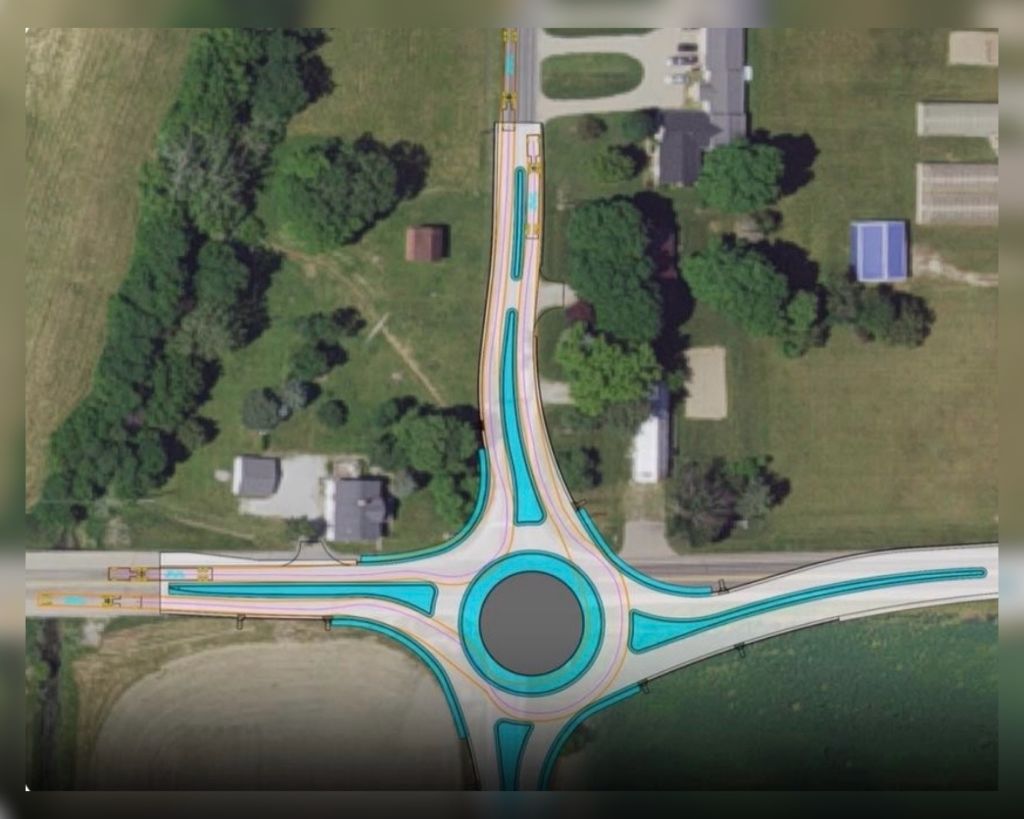
MIDDLETOWN, IN — A growing group of Henry County residents, led by former teacher and business owner Rachel Batthauer, is raising concerns over a proposed INDOT roundabout at the intersection of U.S. 36 and Raider Road.
What the Indiana Department of Transportation (INDOT) calls a “critical safety upgrade” for the community surrounding Shenandoah Schools, residents are calling a “reckless misallocation of taxpayer funds” built on fabricated data and a fundamental misunderstanding of rural Indiana life.
The “Smoking Gun”: Email Exposes Fabricated Fatality
At the heart of the controversy is the justification for the multimillion-dollar project. For months, the narrative pushed by local proponents and INDOT officials centered on a tragic student death occurring at the intersection on the first day of school.
However, a recently surfaced email thread between a concerned resident, Heather, and Shenandoah High School Principal Greg, reveals a different story. When asked about the “first-day fatality” claim, the Principal admitted the tragedy didn’t happen there:
“Yes, there was a fatality on the first day of my tenure as SHS principal,” the Principal wrote. “However, it was not at the intersection where the roundabout is being put in. It was between Emporia and Anderson in Madison County.”
Further investigation into the obituary of the student cited, Kaytlyn Hampton, confirms she passed away in late September—weeks after the first day of school. While her birthday happened to fall on the first day of school that year, the date of her passing had no connection to the start of the academic calendar or the Raider Road intersection.
The Law Enforcement Reality
Despite INDOT’s claims of a “dangerous” history, the data tells a different story. Henry County Sheriff’s Office: Confirms zero fatalities at U.S. 36 and Raider Road. Indiana State Police: Confirms zero fatalities at the intersection.
“I was told by Greenfield INDOT officials, ‘How could I lay my head down at night taking funding from an area where fatal crashes take place regularly?'” Batthauer said. “Easy! It never happened. They are using a child’s death for financial gain while completely ignoring the fact that I buried my own machinist after a fatality at an intersection less than two miles down the same road. They want to spend millions at a school intersection with no growth and a fabricated death, but they won’t put up a $1,500-2,000 flashing light where a man actually died,” Batthauer said.”
Despite Batthauer presenting these findings to state representatives and INDOT officials, she says the response has been a bureaucratic “shrug.” “They told us they are ‘too far down the process’ to make changes, regardless of the facts,” Batthauer said.
The “200-Year” Math Problem
INDOT’s official stance is that while a traffic signal is cheaper to install ($1.4M vs. $2.4M – $5M for a roundabout), the roundabout saves $5,000 annually in “bulb maintenance and electricity.” Residents who did the math say the logic doesn’t hold up:
The Gap: There is at least a $1 million difference in initial cost between a light and a roundabout.
The Payback: At a savings of $5,000/year, it would take 200 years for the roundabout to become more cost-effective than a traditional signal.
The Reality: INDOT officials admitted in a Greenfield meeting that if they don’t spend the allocated federal/state money, they “lose it.”
“They are spending $5 million of our hard-earned tax dollars just so they don’t lose the budget, not because the intersection requires a multi-million dollar fix,” Batthauer argued.
Farming and Logistics: A Design Flaw in the Heartland
Henry County is a thriving farming community. The intersection at Raider Road is a primary artery for agricultural equipment and oversized industrial loads. Residents point to two massive flaws in INDOT’s renderings:
- The 18-Foot Reality vs. the 10-Foot Model
INDOT’s safety models use a 10-foot width for farm equipment. However, local farmers, including Chris Fadely—whose crew traverses that intersection over 50 times a day during peak season—point out that modern combines are actually 18 feet wide. - The Windmill Route
U.S. 36 is a designated route for oversized loads, including 100-foot+ wind turbine blades and fiberglass swimming pools.
The current roundabout design features a non-mountable center island and non-mountable curbs on the exit lanes. Local experts say it will be physically impossible for these loads to navigate the turn, effectively bottlenecking a major Indiana highway.
The Official Stance vs. The Resident Rebuttal
In response to the mounting community pressure, Jordan Yaney, Public Relations Director for INDOT’s Greenfield District, issued a statement defending the project. Yaney maintains that despite resident claims, the intersection of U.S. 36 and Raider Road remains a high-risk area.
“The existing intersection has an above-average incidence of crashes with above-average crash severity in comparison to other intersections with similar traffic volumes,” Yaney stated, noting that many are right-angle collisions, which typically result in more severe injuries. INDOT argues that by reducing conflict points from 32 to just eight, the roundabout will reduce fatalities by 90% and injury crashes by 76%.
Addressing the concerns of the farming community, INDOT claims the “special rural design” is specifically engineered for heavy machinery. According to Yaney, the roundabout features an 18-foot travel lane, a 12-foot mountable truck apron, and five feet of sloped curbing—providing a total of 35 feet of width to accommodate combines and oversized windmill blades.
Furthermore, INDOT clarified the financial aspect, stating the construction contract was awarded in March 2025 for $1.68 million—significantly lower than the initial $2.4 million estimate. Yaney reiterated that while signals are cheaper to install, the roundabout saves $5,000 annually in maintenance and has a 25-year service life, compared to just 10 years for a traffic signal.
INDOT also stated the following:
- Like all safety projects sponsored by INDOT, the roundabout at U.S. 36 and Raider Rd. underwent rigorous scrutiny and review before being selected in the competitive, statewide project selection process. Projects that are funded out of the safety program must show a substantial benefit cost ratio and an evident safety issue to be selected for funding.
- The project design was amended in 2025 to better accommodate large vehicles based on feedback received during public involvement activities, including various meetings and a public hearing held in early 2024. The current design includes a mountable concrete island and truck aprons, as well as sloped curbs, allowing large vehicles such as farm equipment, semis, and oversize loads, specifically wind turbine blades that commonly traverse U.S. 36, to safely navigate the roundabout. With those features combined, a minimum 35 feet of space will be available for these types of vehicles to safely use the intersection. Like all safety projects sponsored by INDOT, the roundabout at U.S. 36 and Raider Rd. underwent rigorous scrutiny and review before being selected in the competitive, statewide project selection process. Projects that are funded out of the safety program must show a substantial benefit cost ratio and an evident safety issue to be selected for funding.
Additional information regarding roundabouts and their benefits is available here: INDOT: Roundabouts.
“The Math Isn’t Mathing”: Residents Fire Back
Rachel Batthauer and her group of researchers were quick to issue a rebuttal to INDOT’s statement, claiming the agency is relying on “generic responses” rather than site-specific facts.
“We dug through the crash reports line by line,” Batthauer countered. “The crashes mostly occur outside of the actual intersection. Most are listed as minor property damage, and injuries are not listed. INDOT has produced no facts on the validity of this location.”
The most glaring contradiction, according to residents, lies in the physical design of the center island. While INDOT claims the roundabout can accommodate oversized loads by allowing them to traverse the center, the design plans tell a different story.
“They say it safely accommodates wind turbines, but the center island is listed as non-mountable in their own design,” Batthauer said. “When we asked how to traverse it, INDOT told us to ‘go straight down the middle.’ You literally can’t have it both ways. You cannot go down the middle of a non-mountable island.”
Batthauer also disputes the $1.68 million contract figure, asserting that once all contingencies and long-term costs are factored in, the price tag will still exceed $5 million.
“INDOT at Greenfield admitted the numbers were preliminary at best just to get the project started. The math isn’t mathing,” Batthauer argued. “We don’t want to hear what a roundabout will do in general. We want to know what it will do for us. If they’ve done their homework, why is it so difficult to show us the documentation?”
State Representative Cory Criswell (R-Middletown) had this say: “I understand why residents have concerns about the proposed roundabout at U.S. 36 and Raider Road, and I’ve spoken with a number of constituents who have shared their frustrations and questions about the project. I drive this corridor daily, so I know how important this intersection is for local families, farmers and businesses. While there has been a fatality in the broader area in the past, I also understand the community wants confidence that the information and data tied to this project are accurate and transparent. I have shared constituent feedback throughout the process and have tried to make sure local voices are heard as discussions continue. Overall, a safe and practical solution for the community is the end goal.”
Henry County Commissioner Steve Dellinger also stated this:
“When this project was first discussed and the County Commissioners were made aware of it. There was much public outcry against it. With basically the only support was from a school administrator. The commissioners at that time went on record saying we were against the project. We met with (via zoom) INDOT and our county engineer to discuss alternatives. It was proposed the possibility of a traffic light with sensors on Raider Rd. to trigger the light only when traffic was on Raider Rd. to stop traffic on U.S. 36. We were told that was not practical. There was much discussion about farm equipment, semi’s, along with the residents living on the corner being able to traverse the round-a-bout.
The position seemed to be pro-active in protecting our school children from imminent doom by installing said round-a-bout. Based I believe on flawed information regarding accidents and fatalities.
Just for clarification, there is a flashing light at that location presently. I believe everyone wants to error on the side of safety especially in regard to our children. That being said the biggest concern has been the lack of visibility to the dwelling on the corner of the intersection. NO one wants someone to lose their home because of a problem that may have been exaggerated to some degree. This has been a topic of concern for as long as most can remember. I still am not convinced a roundabout is the only viable solution.”
The Fight Ahead
Residents have now secured legal counsel to challenge the project, citing negligence and the gross misrepresentation of community needs. Batthauer has taken binders of research to the State House, meeting with:
Matthew Ubelhor Secretary of Transportation and infrastructure
State Representative Cory Criswell
INDOT Commissioner representatives: Valerie Cockrum, Joann Wooldridge, Amy Groff, Andrea Zimmerman, and Lyndsay Quist
County Comissioner: Steve Dellinger
Member of Indiana State Senate: Jeff Raatz
While many officials claimed they were “new to their roles” and unable to stop the momentum of the project, a State Senator reportedly encouraged the group to take their fight to the public.
“They told me the only way to win this is through social media,” Batthauer said. “So, that’s what we’re doing. We’re coming with wisdom, we’re coming with facts, and we’re calling out the baloney.”