Deery Asks Indiana Supreme Court to Take Recount Case

The Republican senator wants the Indiana Supreme Court to take the case — and for the Court of Appeals to stop officials from naming Paula Copenhaver on November ballots.
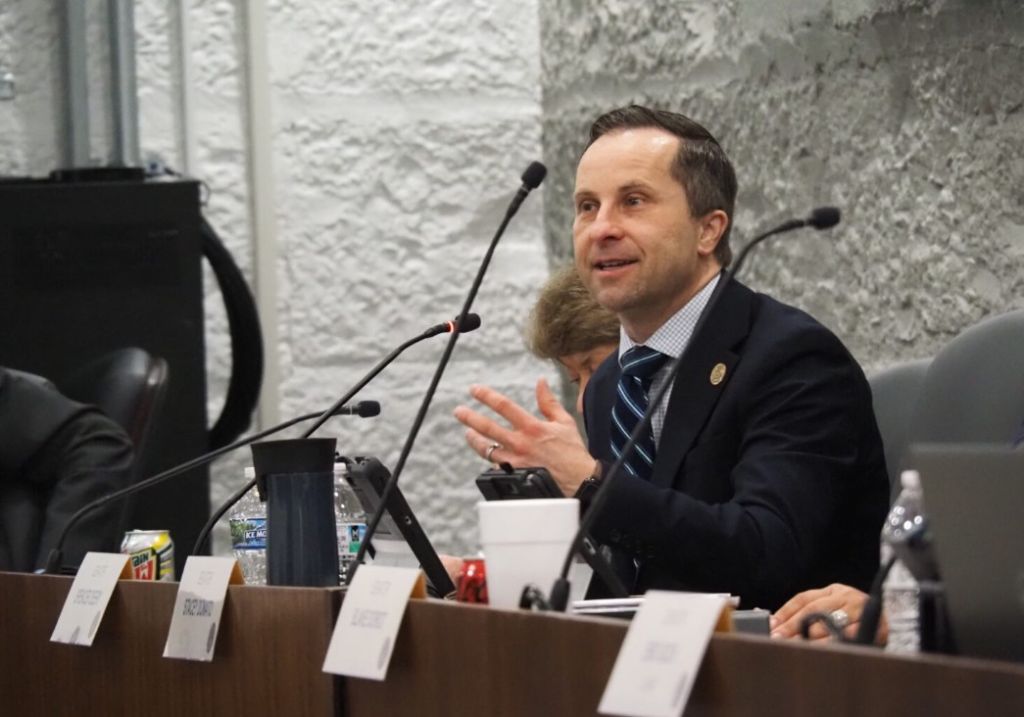
Sen. Spencer Deery, R-West Lafayette, laughs at a joke from a member of the public during testimony on a bill in February 2022. (Photo by Whitney Downard/Indiana Capital Chronicle)
Three votes now separate Republican Paula Copenhaver from state Sen. Spencer Deery, but a dispute over six rejected ballots could reverse the outcome of their Indiana Senate primary for a second time.
Deery’s attorneys on Monday asked the Indiana Supreme Court to take the recount case and the Court of Appeals to suspend the result while judges determine whether the six ballots were wrongly rejected over omissions by election workers.
The Indiana Recount Commission unanimously dismissed Copenhaver’s election contest on Aug. 10 but issued a recount certificate showing her with 6,332 votes and Deery with 6,329.
That reversed the original certified results, which showed Deery winning the May 5 Republican primary by the same three-vote margin, 6,337 to 6,334.
Deery’s appeal is limited to six ballots from Montgomery, Vermillion and Warren counties that lacked a circuit court clerk’s seal and signature. The ballots were cast for Deery, according to his filings, so counting them would put him back ahead by three votes.
We’re not talking about mysterious absentee ballots showing up in the dumpster that we’re trying to count. We’re talking about people who showed their ID and were there in person.
– Sen. Spencer Deery, R-West Lafayette
One of Monday’s filings asks the Indiana Supreme Court to accept an emergency transfer of the case from the Court of Appeals.
The other asks the appeals court to stay the Recount Commission’s certification and temporarily stop election officials from placing Copenhaver’s name on general-election ballots while the dispute is reviewed.
The question for the courts is whether the clerk errors require rejection of ballots that Deery says were otherwise valid.
Deery is represented by Samantha DeWester, who handled the recount proceedings, along with Karen Celestino-Horseman and William Groth. Celestino-Horseman and Groth, both of whom have extensive election-law experience, were added to Deery’s legal team for the appeal.
Copenhaver did not respond Monday to the Indiana Capital Chronicle’s request for comment.
Clerk errors at heart of case
Some of the ballots are classified as absentee ballots under Indiana law but were cast in person before Election Day, Deery said Monday during an interview on the Rob Kendall Show.
“We’re not talking about mysterious absentee ballots showing up in the dumpster that we’re trying to count,” Deery said. “We’re talking about people that showed their ID and were there in person.”
The senator maintained that election workers forgot to affix a stamp, however.
Indiana law requires the back of an absentee ballot to bear the circuit court clerk’s official seal or signature. Deery’s appeal asks whether a clerk’s failure to meet that requirement prohibits an otherwise valid ballot from being counted.
His attorneys point to another provision of Indiana law addressing mistakes by election officials.
“A ballot that has been marked and cast by a voter in compliance with this title but may otherwise not be counted solely as the result of the act or failure to act of an election officer may nevertheless be counted … unless evidence of fraud, tampering, or misconduct affecting the integrity of the ballot is presented by a party to the proceeding,” the statute says.

The law also states that, “The act or failure to act by an election officer is not by itself evidence of fraud, tampering, or misconduct affecting the integrity of the ballot.”
Deery’s attorneys argue that language allows the six ballots to be counted because their defects resulted from election worker omissions rather than anything the voters did.
They also contend Indiana law specifically excludes ballots lacking bipartisan election worker initials from that protection but does not impose the same explicit exclusion on ballots lacking a clerk’s seal and signature.
Deery said votes should not be thrown out solely because of worker incompetence.
“This may be the single biggest threat to election security we’ve seen in Indiana in decades,” he said on Kendall’s show.
Deery noted, too, that election workers could purposefully “forget” to stamp ballots cast by people they believed would vote a particular way based on a person’s hat, skin color or another factor.
“We know these are real ballots. We know these are real voters,” he continued. “We know how they wanted to vote.”
Supreme Court intervention sought
Deery also asked the Indiana Supreme Court to accept an emergency transfer of the case from the Court of Appeals.
Indiana appellate rules permit such a transfer “upon a showing that the appeal involves a substantial question of law of great public importance and an emergency exists requiring a speedy determination,” according to the motion.
His attorneys argue the case meets both conditions because it presents an unresolved question about the effect of election worker errors and because counties are quickly approaching deadlines for preparing, printing and transmitting ballots.

“Because of the error of law by the Commission, an election has been overturned and the clear and undisputed intent of those voters to nominate Spencer Deery has been disregarded, through no fault of their own,” the motion said.
An emergency exists because county clerks need to prepare ballots for the Nov. 3 general election, Deery contends. His attorneys argue the ordinary appellate process might not resolve the case before those ballots must be printed and distributed.
The motion asks the Supreme Court to accept the case and impose an expedited schedule.
Under Deery’s proposal, any party opposing the transfer or proposed schedule would have two days to respond. Deery would have two days to reply after the latest response.
His opening brief would be due five days after the court grants transfer. The other parties would then have five days to respond, followed by three days for Deery to file a reply brief.
Deery has already ordered transcripts and exhibits from the recount proceedings and provided the materials received so far to the other attorneys in the case, according to the motion.
Months-long recount dispute
The court case is the latest turn in a Republican primary that has gone unsettled for more than three months.
Both candidates originally claimed victory, but completed county tallies later gave Deery a three-vote win after provisional ballots were reviewed.
Copenhaver requested a recount and election contest. She alleged that some people improperly voted in the Republican primary despite identifying as Democrats or progressives.
Copenhaver’s lawyers initially sought to question 14 voters under oath about whether they complied with Indiana’s primary-election law and, potentially, how they voted.
The request prompted objections that voters could be compelled to disclose private political information or reveal their ballots.
Deery denounced the effort as an attempt to intimidate voters and discard lawful votes. His attorney argued that voters can change their party preference and that Indiana does not require formal party registration before someone participates in a primary.
The Recount Commission denied the proposed voter subpoenas but continued reviewing ballots disputed for other reasons.
The recount ultimately reduced both candidates’ totals. Deery lost eight votes from his certified total, while Copenhaver lost two, leaving Copenhaver ahead by three.
Copenhaver had the endorsement of President Donald Trump. Deery was among the Republican senators Trump targeted after they opposed the president’s push for a mid-decade redrawing of Indiana’s congressional districts.
The hostile primary attracted millions of dollars in outside spending as Trump and his allies sought to defeat Republican senators who opposed the redistricting plan.
Copenhaver is a staffer for Lt. Gov. Micah Beckwith and a Fountain County clerk. She also serves as the Fountain County Republican chair.
Deery, a first-term senator from West Lafayette, represents the heavily Republican district spanning all or parts of six counties between Lafayette and Terre Haute.
The eventual Republican nominee is set to face Democrat David Sanders, a West Lafayette City Council member, in November.