Ball State Pays $225K to Settle Fired Employee’s ACLU Lawsuit

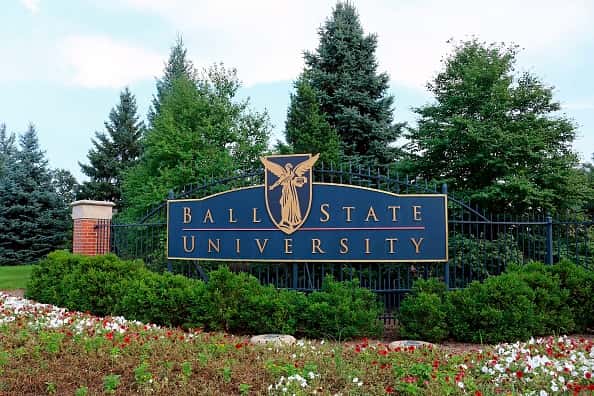
INDIANAPOLIS — The ACLU of Indiana has finalized a $225,000 settlement in a high-profile First Amendment lawsuit against Ball State University President Geoffrey Mearns.
The legal battle stemmed from the termination of Suzanne Swierc, a University Director who was fired after publishing a private social media post regarding a matter of public concern.
The settlement completely resolves the constitutional claims brought against the public university. In addition to the monetary payout, the agreement stipulates that Ball State employees may freely serve as professional references for Swierc and that her former supervisors will officially acknowledge her positive contributions to health promotion and advocacy work during her tenure.
The controversy began on the evening of September 10, 2025. Swierc, who was serving as the Director of Health Promotion and Advocacy within the Division of Student Affairs, made a post on her private Facebook page while at home.
In the post, Swierc addressed the death of conservative public figure Charlie Kirk. She characterized his death as a tragedy, wrote that she prayed for his soul, and noted that while his death reflected the hatred, fear, and violence he sowed, absolutely nothing excused his killing. She also stated that “If you think Charlie Kirk was a wonderful person, we can’t be friends,” and also how Kirk excused the deaths of children in the name of the second amendment.
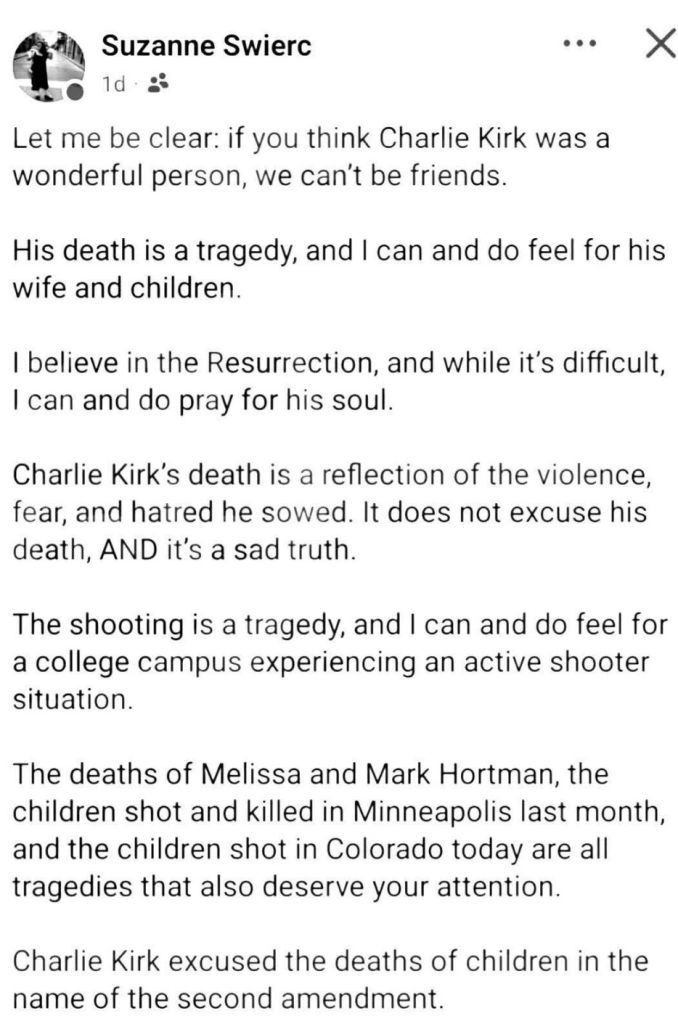
Despite personal privacy settings on her Facebook page, an unknown individual captured a screenshot of the post. The screenshot was combined with information pulled from Ball State’s public staff directory and quickly was spread online. Within 48 hours, the post was submitted to Indiana Attorney General Todd Rokita’s “Eyes on Education” portal and amplified by public-facing social media accounts, triggering immediate online harassment and threats against Swierc.
On September 15, university officials met with Swierc to question her about her privacy settings and the capacity in which she made the post. Though no disciplinary warnings were issued during that initial meeting, the university shifted its stance two days later. On September 17, Swierc was called into a meeting and told her employment was terminated effective immediately.
A formal termination letter signed by President Geoffrey Mearns explicitly cited the private Facebook post as the sole justification for her firing, offering her no mechanism to challenge or appeal the decision. ACLU of Indiana Staff Attorney Josh Bleisch, who served on the legal team, emphasized that the university’s swift actions overstepped basic constitutional boundaries.
“This case raised a really important but basic constitutional question, that is whether a public university can fire an employee for speech that she made as a private citizen outside the scope of her job when that speech is on a matter of public concern,” Bleisch explained. “The post had nothing to do with her job duties. She was speaking solely in her personal capacity, and it didn’t interfere with her work or university functions.”
Because Ball State is a state-funded public university, it is bound by the First Amendment and cannot legally retaliate against employees exercising free speech as private citizens.
Stevie Pactor, Senior Staff Attorney at the ACLU of Indiana, reiterated that the law remains incredibly clear in these circumstances:
“Suzanne was speaking as a private citizen on a matter of public concern when Ball State fired her over a private social media post,” Pactor stated. “The First Amendment does not allow government institutions to retaliate in those circumstances, and this settlement reflects that.”
Reflecting on the resolution of the case, Swierc described the eight-month legal battle as an incredibly traumatic experience, but noted she felt compelled to challenge the university because the action was fundamentally wrong.
“I challenged my termination simply because it was wrong,” Swierc said. “My voice and my rights matter, but those of all public employees matter as well. I hope that the nature of my case signals to state employees and employers alike that our First Amendment rights must be protected.
These rights are worth fighting for, and I hope that people will be able to see the forest through the trees and understand the dangers of silencing our voices.”
The comprehensive settlement agreement was fully executed by both legal parties late last week, permanently concluding the federal lawsuit.