Braun Extends Gas Tax Holiday Through July

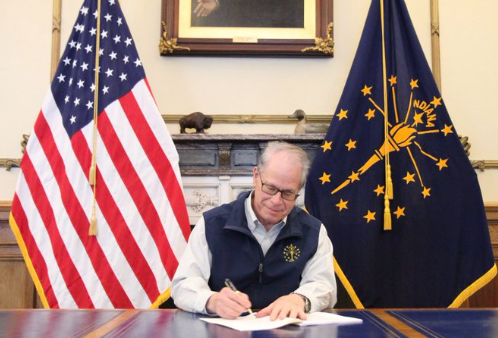
INDIANAPOLIS — Asserting that Indiana remains the “shining star of the Midwest,” Governor Mike Braun announced a second extension of the state’s historic gas tax holiday, stretching relief for Hoosier motorists through the end of July 2026.
The move continues the complete suspension of both the 7% Gasoline Usage Tax and the $0.36 per gallon Gasoline Excise Tax. Together, the dual reprieves slash more than 62 cents per gallon at the pump, keeping Indiana’s fuel prices the lowest in the nation. According to AAA, Indiana leads the country with an average price of $3.585 for a gallon of regular.
“Indiana has the cheapest gas in the country because we are using every tool in the toolbox to save Hoosier families money,” Braun said. “Affordability is my number one priority.”
During his press briefing, Governor Braun cast the ongoing tax cuts as an essential economic shield against structural inflation inherited from the federal level.
“The affordability issue is real,” Braun emphasized. “And that doesn’t just mean gas prices. It means property taxes. It means utility rates. It means probably the thing that we all fear most when we need it, healthcare costs… This gas savings is kind of a lifeline through a tough period like this.”
The state’s ability to absorb the steep fiscal impact—estimated at roughly $50 million per month for the usage tax and $90 million per month for the excise tax—stems from a resurgent state treasury. Braun noted that state revenues are heavily outperforming the “faulty” budget forecasts of April 2025.
While motorist relief has been widely welcomed, the suspension temporarily starves infrastructure funds. Local governments typically receive 30% to 35% of these tax revenues to maintain local roads.
Addressing municipal concerns, Braun promised that local governments will be made completely whole via state surpluses. “They should be able to get reimbursed fully. Why? Because we’re running our state well,” Braun insisted, pointing to operational overhauls led by private-sector minds. “I had eight entrepreneurs, private-sector individuals, come into state government to help run it more like a business… That could accumulate into a billion dollars of savings over time within a year.”
Braun also credited Indiana’s explosive, aggressive economic trajectory for generating the necessary backfill revenue.
“Our economy is growing twice as fast as Ohio’s, Illinois’s, three times as fast as Kentucky’s, six times as fast as Michigan’s,” Braun said. “Wages are going up. Revenues are coming in. That’s because businesses want to come here.”
Though the Indiana Department of Transportation (INDOT) and local entities will tap into reserves and state cash flows to prevent any current project cancellations, Braun acknowledged that short-term relief highlights a deeper legislative challenge. The state’s foundational road funding mechanics have not been comprehensively adjusted since 2017, and gas tax revenues are naturally beginning to flatten.
“Long-term road funding is an issue the legislature is going to have to take up, and all Hoosiers are going to have to have that discussion,” Braun noted, adding that highly trafficked shipping corridors like Interstate 70 cost $170 million simply to maintain in their current condition.
The emergency tax suspension is legally executed under Indiana’s energy emergency statute, which grants the executive branch up to 120 days of total localized authority. While Braun noted the tax holiday will formally extend through the end of July, he left the door open for further evaluations ahead of the upcoming legislative budget session.