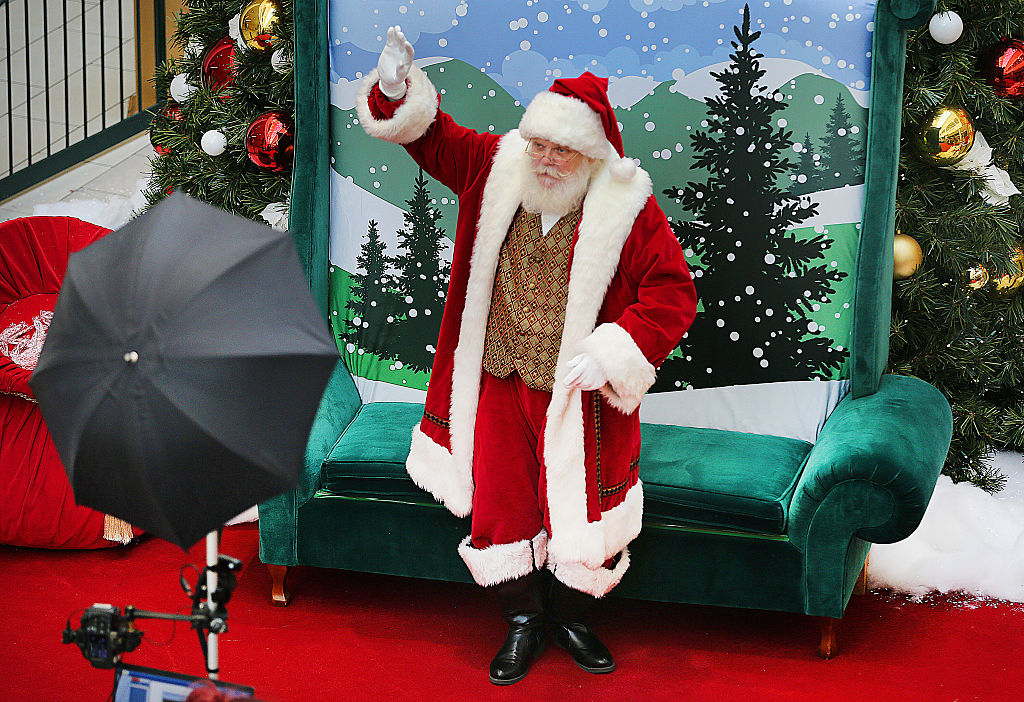
Santa inspired by St. Nicholas, a 4th-century bishop known for kindness and secret gift-giving.
Santa's red suit popularized by Coca-Cola, earlier depictions showed him in bishop's attire.
Santa's elves, reindeer, and chimney tradition have roots in Scandinavian and Norse mythology.
Source: Boston Globe / Getty
20 fun and fascinating facts about Santa Claus
1. Santa’s Origins
Santa Claus is inspired by St. Nicholas, a Greek bishop from the 4th century who lived in what is now Turkey. He was known for his kindness and secret gift-giving, such as leaving coins in people’s shoes.
2. The Name “Santa Claus”
The Dutch settlers in America brought the tradition of “Sinterklaas,” which evolved into “Santa Claus” in English. The name reflects the blending of cultures over time.
3. Red Suit History
While Coca-Cola popularized the modern image of Santa in red, earlier depictions in the 19th century by artists like Thomas Nast also showed him in red robes, inspired by St. Nicholas’s traditional bishop attire.
4. North Pole Headquarters
Love Lifestyle? Get more! Join the WIBC 93.1 FM Newsletter
The idea of Santa living at the North Pole was popularized in the 19th century, symbolizing a remote, magical place far from the everyday world.
5. Santa’s Elves
The concept of Santa’s elves originated in Scandinavian folklore, where elves (or “nisse”) were believed to be magical helpers who protected homes and brought good fortune.
6. The Naughty and Nice List
This tradition likely stems from St. Nicholas’s reputation for rewarding good behavior. It’s a fun way to encourage children to be on their best behavior during the year.
7. Reindeer Power
Santa’s reindeer first appeared in the 1823 poem “A Visit from St. Nicholas” (commonly known as “The Night Before Christmas”), which introduced Dasher, Dancer, Prancer, Vixen, Comet, Cupid, Donder, and Blitzen.
8. Rudolph’s Creation
Rudolph the Red-Nosed Reindeer was created by Robert L. May in 1939 as a promotional storybook for Montgomery Ward. His story of overcoming adversity became an instant classic.
9. Santa’s Sleigh Speed
Scientists and mathematicians have calculated that Santa would need to visit 822 homes per second to deliver gifts worldwide, making his sleigh the fastest “vehicle” ever imagined.
10. Chimney Tradition
In Norse mythology, Odin would enter homes through chimneys during the Yule season. This idea carried over into European folklore and eventually became part of Santa’s story.
11. Santa’s Laugh
The hearty “Ho, Ho, Ho!” is meant to reflect Santa’s jolly and approachable nature, making him a figure of joy and warmth.
12. Global Names
Santa is known by different names around the world, reflecting local traditions. For example, in Italy, he’s called “Babbo Natale,” and in Germany, he’s “Weihnachtsmann.”
13. Santa Tracker
The NORAD Santa Tracker began in 1955 when a misprinted Sears ad gave children a hotline to call Santa. Instead, they reached NORAD, and the tradition of tracking Santa’s journey was born.
14. Santa’s Age
St. Nicholas was born around 270 AD, making Santa over 1,750 years old. His timelessness adds to his magical appeal.
15. Magic Sack
Santa’s sack is often depicted as bottomless, a symbol of his ability to bring joy to every child, no matter how many gifts are needed.
16. Milk and Cookies
This tradition likely started during the Great Depression as a way for families to show gratitude for what they had, even in tough times. It’s now a beloved part of Christmas Eve.
17. Santa’s Favorite Food
While cookies are a staple in the US, other countries have their own traditions. In the UK, Santa gets mince pies, and in Sweden, he might enjoy rice pudding.
18. Santa’s Post Office
Santa receives millions of letters each year. In the US, the USPS’s “Operation Santa” program allows volunteers to respond to children’s letters, spreading holiday cheer.
19. Santa’s Helpers Worldwide
In Germany, Santa is accompanied by Krampus, a mischievous figure who punishes naughty children. In the Netherlands, Zwarte Piet helps deliver gifts.
20. Santa in Space
In 1965, astronauts aboard Gemini 6 played a prank by reporting a “sleigh in orbit” and playing “Jingle Bells” on a harmonica. It was the first song ever played in space, adding a cosmic twist to Santa’s legend.