Young: Fading Local News Is a Fundamental Threat to Democracy
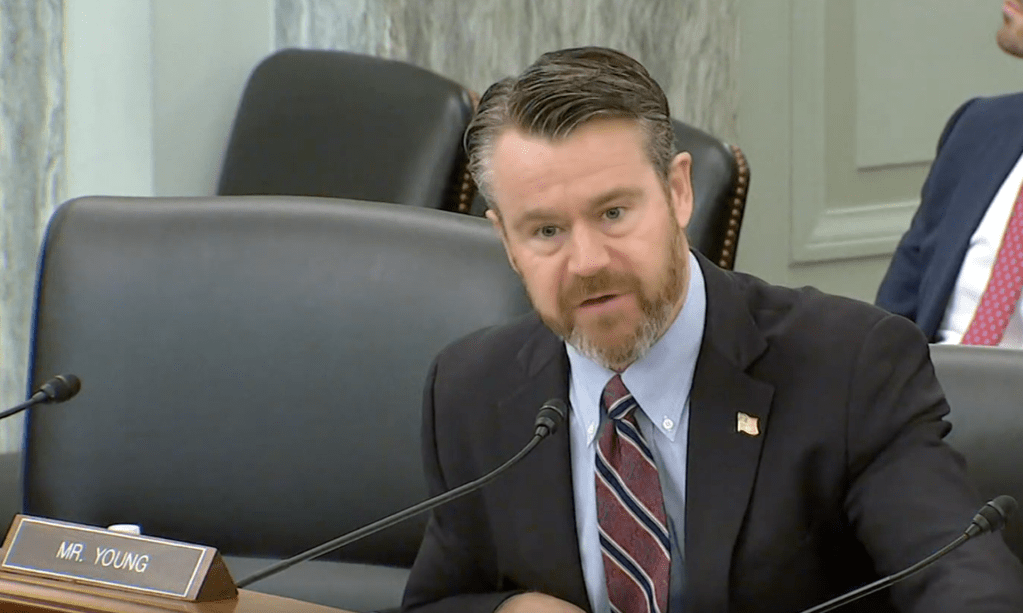
WASHINGTON — U.S. Senator Todd Young (R-Ind.) issued a stark warning on Tuesday, arguing that the decline of local news is not just a business crisis, but a fundamental threat to American democracy.
During a Senate Commerce Committee hearing titled “We Interrupt This Program: Media Ownership in the Digital Age,” Young emphasized that local journalism provides the “feedstock” necessary for citizens to engage with their communities and hold local governments accountable.
Senator Young highlighted how the lack of access to local reporting creates an information vacuum that hampers civic participation.
“If members of my community don’t have access to their local news, it can be an impediment to useful information and the decisions they make, the actions they take,” Young said. “But, I actually think what’s most at stake is our democracy. If I don’t know what’s happening in the local planning meeting, if I don’t know what’s happening in the school board, if I don’t know where monies are being invested locally as it relates to road projects, it’s hard for me to cast informed votes at the ballot box.”
Young personalized the issue, stating that without local outlets, it becomes nearly impossible for even highly engaged citizens to stay informed on the issues that affect their daily lives. “It’s hard for me to meaningfully engage in democracy at the local level,” he added.
The hearing also addressed the “twisted phenomenon” of local news becoming nationalized. Young and witnesses noted that as local newsrooms shrink, many remaining outlets lean into national political narratives rather than focusing on community-specific issues.
Witness Steven Waldman, a local news advocate, noted that this trend leads to increased polarization. “When local news contracts… you don’t have the news about the things that bind us together, whether it’s the high school sports team or the inspiring teacher that just passed away,” Waldman testified. “These are things that make people look at their neighbors as actual neighbors instead of caricatures.”
The central focus of the hearing was the FCC’s current 39% national television ownership cap. Broadcasters, represented by National Association of Broadcasters (NAB) President Curtis LeGeyt, argued that the cap is an “antiquated” relic of the analog era.
LeGeyt testified that local stations are struggling to compete for advertising dollars and viewers against “global behemoths” like Google, Netflix, and Amazon. He argued that allowing broadcasters to scale up through mergers—such as the pending $6.2 billion acquisition of TEGNA by Nexstar Media Group — is essential to fund expensive local journalism.
“No one else in media has boots on the ground when that storm rolls through,” LeGeyt said. “We need scale in order to better compete and that scale is going to pay for that localism.”
Young pointed to a recent study highlighting a growing paradox: while it is easier than ever to access national and international news, it is increasingly difficult for Hoosiers to find news about their own neighborhoods.
He concluded by urging his colleagues to look beyond the interests of “business people and investors” and consider the long-term health of Indiana communities. “We need to be able to debate the merits and demerits of ownership decisions… within the context of community,” Young said.