Nighttime Severe Weather Threat Across Indiana Sunday
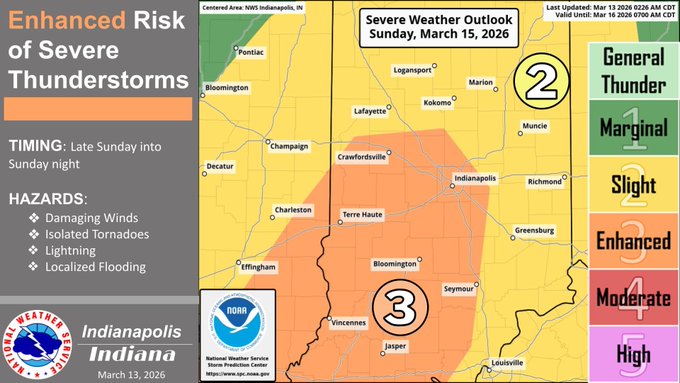
STATEWIDE — Forecasters are watching the potential for severe weather across Indiana late Sunday, with the greatest threat after sunset when storms could bring strong winds and isolated tornadoes.
“This looks like it could be a fairly substantial threat for severe weather Sunday night, mostly after sunset,” said Matt Eckhoff, meteorologist with the National Weather Service in Indianapolis. “That makes it one of those nighttime severe weather events, which are always more challenging.”
Nighttime storms are riskier because people are often asleep and less likely to receive warnings.
Forecasters expect the threat to cover the entire state as a strong weather system approaches. The primary hazards are damaging straight-line winds and isolated tornadoes.
“In this type of environment you often see a lot of straight-line wind damage, with some isolated tornadoes mixed in,” Eckhoff said.
Meteorologists note strong wind shear—changes in wind speed and direction with height—could organize thunderstorms and allow some to rotate.
“When you have that shearing effect in the atmosphere, it causes the air to gain some rotation and spin,” Eckhoff said. “That helps organize thunderstorms from just regular storms into rotating thunderstorms.”
Rotating storms can increase tornado potential, though forecasters say it’s too early to know how storms will evolve.
“All tornadoes are different,” Eckhoff said. “You never really know what you’re going to get until the storms actually develop.”
Storms expected with this system—like squall lines or broken lines—tend to produce weaker tornadoes than long-lived supercells but can still cause damage.
Leading up to Sunday night, conditions are mostly calm. Saturday should be dry, with winds turning southerly and gradually warming southern Indiana. Sunday will stay mostly calm during daytime hours, though windy.
“You’ll probably notice those winds picking up as warmer air streams in from the south,” Eckhoff said. “Wind gusts could reach between 40 and 50 miles per hour Sunday, even outside of thunderstorms.”
Forecasters encourage residents to review severe weather safety plans and ensure they have a way to receive warnings while sleeping. The National Weather Service will continue monitoring the system and provide updates as the threat develops.