House Passes SAVE America Act in 218-213 Vote
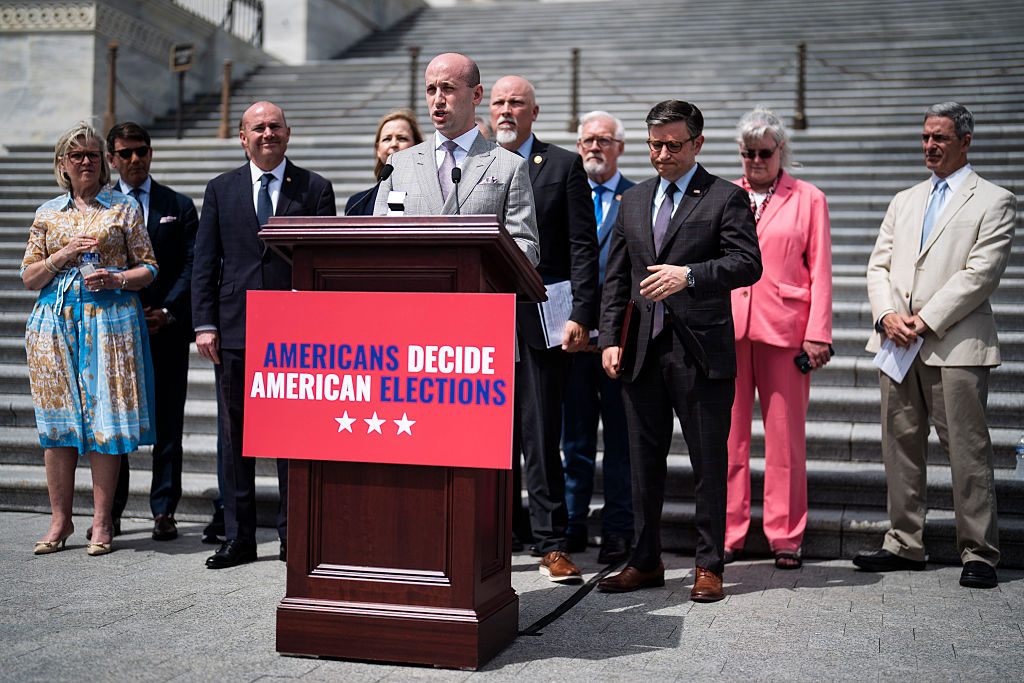
The Republican-controlled House on Wednesday passed the SAVE America Act, a sweeping elections bill that President Donald Trump has urged Congress to approve.
The measure cleared the chamber in a 218-213 vote. Republicans unanimously supported the bill, while all but one Democrat opposed it. Rep. Henry Cuellar, D-Texas, was the only Democrat to vote in favor.
The 32-page legislation would require states to obtain documentary proof of citizenship “in person” — such as a U.S. passport or birth certificate — before registering someone to vote in a federal election.
The revised bill, updated to incorporate new demands from Trump, also mandates that voters present photo identification to cast ballots in person. It further establishes new requirements for mail-in voting, directing voters to submit a copy of an approved ID both when requesting and returning an absentee ballot.
“It’s just common sense. Americans need an ID to drive, to open a bank account, to buy cold medicine, to file government assistance,” Speaker Mike Johnson, R-La., told reporters. “So why would voting be any different than that?”
Democrats argue the proposal is intended to suppress voters, emphasizing that voting by noncitizens is already illegal and exceedingly rare. Under current law, voters must affirm their citizenship under oath, with criminal penalties for false claims.
“This is a desperate effort by Republicans to distract,” House Minority Leader Hakeem Jeffries, D-N.Y., told reporters. “The so-called SAVE Act is not about voter identification, it is about voter suppression. And they have zero credibility on this issue.”
Jeffries and other Democrats point to Trump’s recent comments expressing a desire to “nationalize” elections and “take over the voting in at least — many, 15 places.” They argue such proposals conflict with the Constitution, which grants states authority over the “Times, Places and Manner of holding Elections” for federal office. Democrats have also highlighted the FBI’s seizure of ballots and voter records from Fulton County, Georgia, as Trump continues to falsely claim he won the 2020 election.
Republicans counter that voter ID requirements are broadly popular. An August survey from the Pew Research Center found that 83% of U.S. adults support “requiring all voters to show government-issued photo identification to vote.” That figure includes 71% of Democrats and 76% of Black voters, a group some Democrats and liberal advocates argue would be disproportionately affected.
The bill was introduced by Rep. Chip Roy, R-Texas, and Sen. Mike Lee, R-Utah, and now advances to the Senate, where its prospects are uncertain. Republicans hold 53 seats, but several members have expressed skepticism or opposition.
Sen. Lisa Murkowski, R-Alaska, voiced her opposition this week, reminding colleagues that Republicans opposed federal election mandates as recently as 2021.
“When Democrats attempted to advance sweeping election reform legislation in 2021, Republicans were unanimous in opposition because it would have federalized elections, something we have long opposed,” she said. “Now, I’m seeing proposals such as the SAVE Act and MEGA that would effectively do just that. Once again, I do not support these efforts.”
Sen. Susan Collins, R-Maine, has also raised concerns about the revised legislation.
“Senator Collins supports the law and constitutional interpretation that only American citizens are eligible to vote in federal elections. She also supports voter ID. So she supported the original SAVE Act,” a Collins spokesperson told NBC News. “There were problems with the SAVE America Act because it went much broader than these original principles and we hope those issues are being addressed by the bill’s authors and the House.”
Sen. Mitch McConnell, R-Ky., the former GOP leader who spearheaded opposition to Democrats’ unsuccessful voting-rights legislation in 2021 and 2022, has long maintained that elections should be administered by states without federal mandates.
Even if the measure secures a simple majority in the Senate, it lacks a path to the 60 votes required to overcome a filibuster, as Democrats remain firmly opposed.
Senate Minority Leader Chuck Schumer, D-N.Y., said the proposal “would impose Jim Crow type laws to the entire country and is dead on arrival in the Senate.”
Senate Majority Leader John Thune, R-S.D., said Tuesday that Republicans are engaged in a “robust” discussion about the bill. He voiced support for bringing it to the floor but acknowledged procedural hurdles remain.
“How we get to that vote remains to be seen,” Thune said, while emphasizing that Senate Republicans oppose eliminating the 60-vote threshold despite pressure from the president. “There aren’t anywhere close to the votes — not even close — to nuking the filibuster.”