Banks Challenges NIH Over $2.6B Indiana Funding Gap
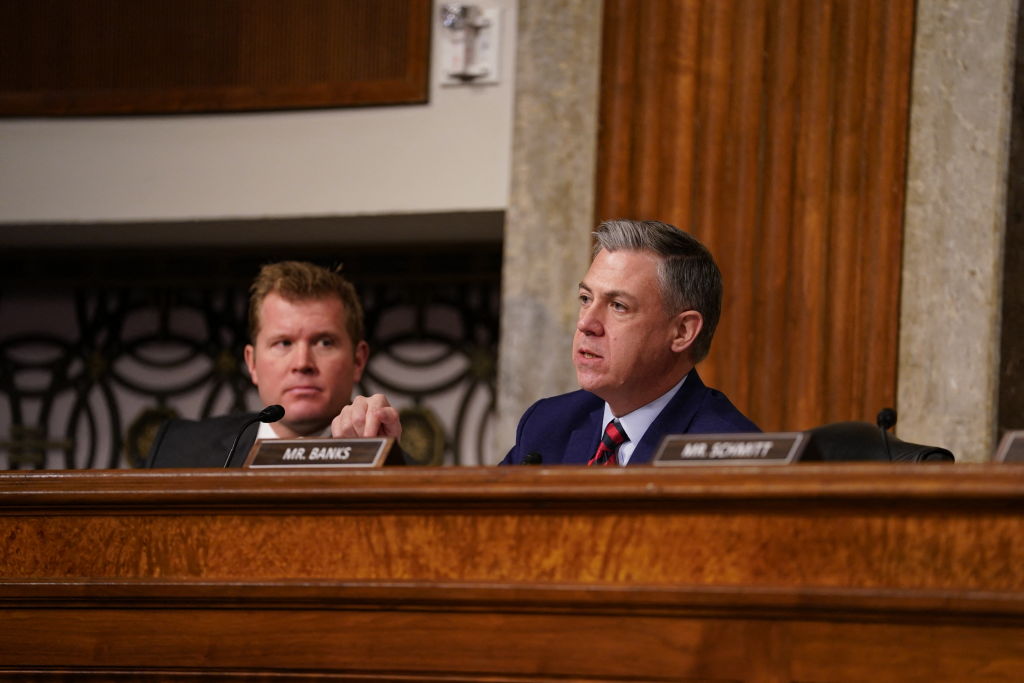
WASHINGTON, D.C. — In a high-stakes Senate hearing Tuesday, Senator Jim Banks (R-Ind.) pressed National Institutes of Health (NIH) Director Dr. Jay Bhattacharya over what he called a “geographic concentration” of federal funding that leaves premier Indiana research institutions behind.
During the Senate Health, Education, Labor, and Pensions (HELP) Committee hearing, titled “Modernizing the National Institutes of Health: Faster Discoveries, More Cures,” Banks highlighted a stark disparity in how medical research dollars are distributed across the country.
Banks pointed out that while Indiana is home to three elite R1 research institutions — Indiana University, Purdue, and Notre Dame — the state’s federal support does not reflect its scientific output.
“Indiana only got about $350 million of NIH funding last year,” Banks noted. “To contrast that, the state of Massachusetts, which is virtually the same size as my state, received nearly $3 billion last year. What’s going on here?”
Banks argued that Indiana is already delivering groundbreaking results, citing IU’s Alzheimer’s research, Purdue’s work on opioid addiction and cancer-related genes, and Notre Dame’s fight against antibiotic-resistant malaria.
“Those are just a few examples of the type of important research going on in my great state to make Americans healthier,” Banks said.
Dr. Bhattacharya acknowledged the Senator’s concerns, describing the current funding model as a “catch-22” that favors established coastal hubs. Currently, NIH facility funding is tied to having researchers who have already won grants, but attracting those researchers requires high-end facilities.
“The way that we fund the facilities is tied to having great researchers already there… In order to attract great researchers, you have to have great facilities,” Bhattacharya explained. “It guarantees that our funding is going to be concentrated.”
Bhattacharya proposed a “market-based” solution to break this cycle—one that Banks signaled he would support. The Director suggested that if a school like Purdue can provide lab space more inexpensively than a coastal counterpart, they should receive a “leg up” in securing that money.
Beyond the funding debate, Banks also took a moment to laud the administration’s focus on the “exponential increase” in autism cases, which has risen from roughly 1-in-30,000 in 1985 to 1-in-31 today.
“This doesn’t seem like a Republican or Democrat issue; it seems like one that we should all be thanking you and this administration for doing more to figure out what’s causing it,” Banks said. “There are a lot of families in Indiana that are affected that appreciate that focus.”
Banks concluded by calling for a more competitive process that ensures “geographic diversity,” warning that concentrating funds in only a few coastal pockets leads to “scientific groupthink.”