House Advances Death Penalty Protections; Firing Squad Bill on Hold
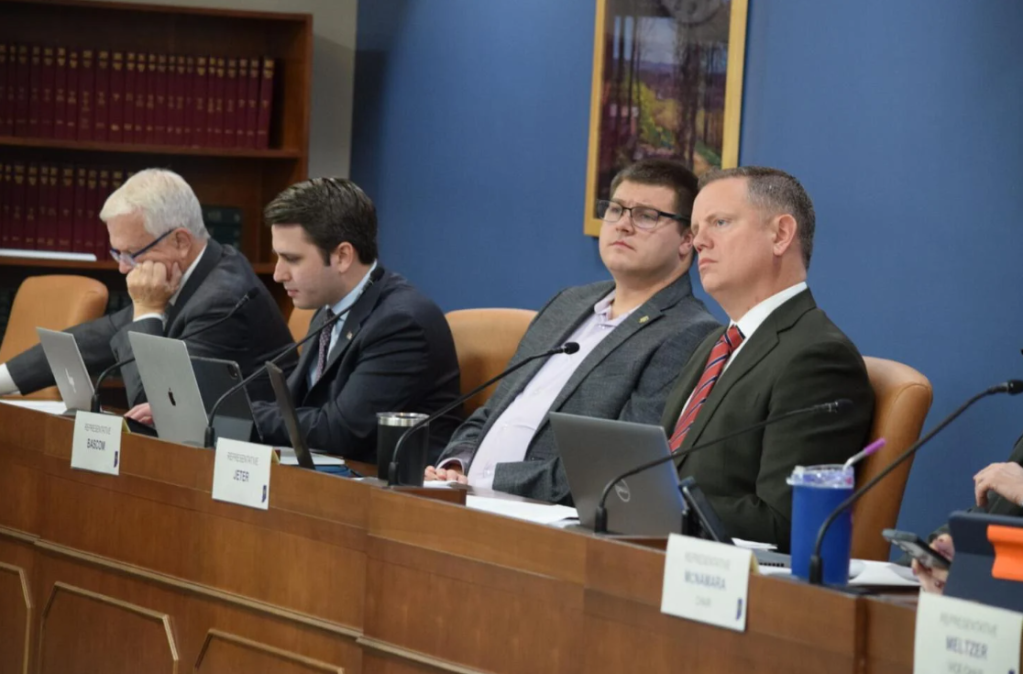
STATEHOUSE — An Indiana House committee unanimously advanced a bill Wednesday tightening protections for defendants with intellectual disabilities in capital cases, while a Senate proposal allowing firing squad executions remains on hold as lawmakers approach key legislative deadlines.
Other death penalty-related bills filed this session have yet to receive hearings.
Legislators have just two weeks to move legislation to the House and Senate floors. Bills must advance from committees by Jan. 26 and to opposing chambers by Jan. 29.
The House Courts and Criminal Code Committee on Wednesday unanimously advanced to the full chamber House Bill 1432, authored by Rep. Garrett Bascom, R-Lawrenceburg, which would prohibit the state from seeking the death penalty against a defendant if a court determines at any time before trial that the defendant has an intellectual disability.
Under current law, the court must make that determination within a more narrow, early pretrial window.
Bascom told committee members the bill is intended to address a procedural gap — not alter Indiana’s long-standing policy barring execution of people with intellectual disabilities.
“It doesn’t change anything substantive,” Bascom said. “What we’re attempting to do here is make sure that anybody with an intellectual disability does not fall through the cracks in the process.”
Bascom noted that defendants currently must raise intellectual disability as a defense no more than 20 days before the omnibus date, which can arrive quickly after charges are filed.
“When I was a public defender,” he said, “sometimes it can be difficult to really get your feet underneath you” within that short window.
Before voting, the committee approved additional language in the bill that creates an automatic process to evaluate defendants for intellectual disability once prosecutors seek the death penalty.
Bascom explained that after the state files notice of intent to seek a death sentence, the court would appoint at least two independent evaluators to assess the defendant. Their reports would initially be shared only with defense counsel.
“After the review of the second report, then they will have 30 days to raise the defense and then the judge has to decide this before trial,” Bascom said. “I’ve attempted to bring all the stakeholders together to come into the sweet spot so that we don’t have anybody fall through the cracks as it relates to the death penalty, and as it relates to somebody that specifically has this intellectual disability.”
Examples of intellectual disabilities include, but are not limited to, persons with Down Syndrome and Fetal Alcohol Spectrum Disorder.
‘Straightforward and important’
Tom Crishon, with The Arc of Indiana, testified in support of the bill as amended, calling its purpose “straightforward and important.”
“The purpose of the bill … is to ensure that individuals with an intellectual disability are not subjected to the death penalty in Indiana,” he said. “This has long and properly been the policy of the state and reflects federal constitutional law.”
Crishon said Indiana’s current statute prioritizes procedural deadlines over accuracy.
“Intellectual disability can manifest in different and often subtle ways,” he added. “It is not always obvious at the onset of a case.”
Crishon additionally said the bill does not presume a finding of intellectual disability, but instead ensures the issue is affirmatively considered by qualified professionals.
“Ensuring accuracy at the onset is not only constitutionally sound, but is fiscally responsible,” Crishon said.
If defendants in active capital cases are determined to have an intellectual disability early in proceedings, the state could save an estimated $260,000 per case in public defense costs alone, largely because death penalty cases require two attorneys and higher reimbursement rates, according to a legislative fiscal analysis.
Counties could also avoid hundreds of thousands of dollars in jury trial and indigent defense expenses.
The Indiana Catholic Conference also voiced support. Roarke LaCoursiere, speaking on behalf of Indiana’s Catholic bishops, said the bill adds “an additional measure of scrutiny” in capital cases.
“Although the Catholic Church teaches that the use of the death penalty is inadmissible in all cases,” Lacoursiere said, “we are here to offer support for House Bill 1432.”
Public defenders urge caution
The Indiana Public Defender Council testified in neutrality but cited concerns from capital defenders about the bill’s automatic evaluation process.
Zach Stock, appearing on behalf of the council, said efforts to reduce error in death penalty cases are critical, including errors related to intellectual disability, mental health and sanity determinations.
“The error rate is unacceptably high,” Stock said. “Anything that could attempt to reduce that error rate is something that we should appreciate and champion.”
However, he said capital defenders worry the process could “make it worse by complicating their control and potentially tainting” evaluations through what he described as the “anchoring effect,” where early assessments influence later conclusions.
“If an evaluation gets away from a defender, and it’s not done right — not done well — they’re tainted for years,” Stock said.
Bascom acknowledged those concerns and said he would continue working with public defenders as the bill moves forward.
Firing squad bill remains on hold
A separate death penalty proposal in the Senate stalled this week, however.
Senate Bill 11, authored by Sen. Mike Young, R-Indianapolis, would add execution by firing squad as an option under Indiana law. The bill was heard in committee last week and placed on the Senate Corrections and Criminal Law Committee agenda for Tuesday, but committee chair Sen. Aaron Freeman, R-Indianapolis, declined to amend or vote on it.
In brief comments during Tuesday’s meeting, Freeman made clear that “Indiana is a death penalty state … and as long as I have a say, Indiana is going to continue to be a death penalty state.”
He warned, though, that efforts to eliminate capital punishment through litigation or other avenues could backfire.
“For those of you that disagree, fine, good. People can disagree, and we can do so respectfully,” Freeman said. “I would just say this — be careful what you wish for, because it just might come true the more you want to try to eliminate something.”
In comments to the Indiana Capital Chronicle after the hearing, Freeman said he would “prefer for executions to continue to happen by lethal injection,” which he called “the most humane,” but said he has not decided whether the bill will be called for a vote next week.
Freeman said he recently met with the Indiana Department of Correction, which he said raised “some concerns,” though he did not provide details.
Noelle Russell, a spokesperson for the Department of Correction, told the Capital Chronicle the agency has no position on the bill, currently. The department has not testified publicly on the proposal.
Several amendments to Senate Bill 11 have been filed but have not been taken up by the corrections committee.
One amendment would authorize DOC to carry out executions by firing squad only if the commissioner determines it is “advisable in light of availability considerations and the resources of the department.” The proposed changes would also require the agency to establish a dedicated room and execution protocol before any firing squad execution occurs.
A new state prison is under construction in Westville, but it’s unclear if such a room is included — or possible — in current building plans.
Other death penalty bills without action
Several additional death-penalty-related bills filed this session have not yet been scheduled for hearings.
House Bill 1119, authored by Reps. Jim Lucas, R-Seymour, and Andrew Ireland, R-Indianapolis, would allow executions by firing squad or nitrogen hypoxia while keeping lethal injection as the default method unless an inmate requests otherwise.
Another Ireland proposal, House Bill 1314, would seek to speed up post-conviction relief proceedings, potentially shortening the time inmates spend on death row.
Separately, House Bill 1287, filed by Rep. Bob Morris, R-Fort Wayne, would require members of the General Assembly to volunteer to serve on execution teams and make their names public records.