Artemis II Marks Bold Return to the Moon
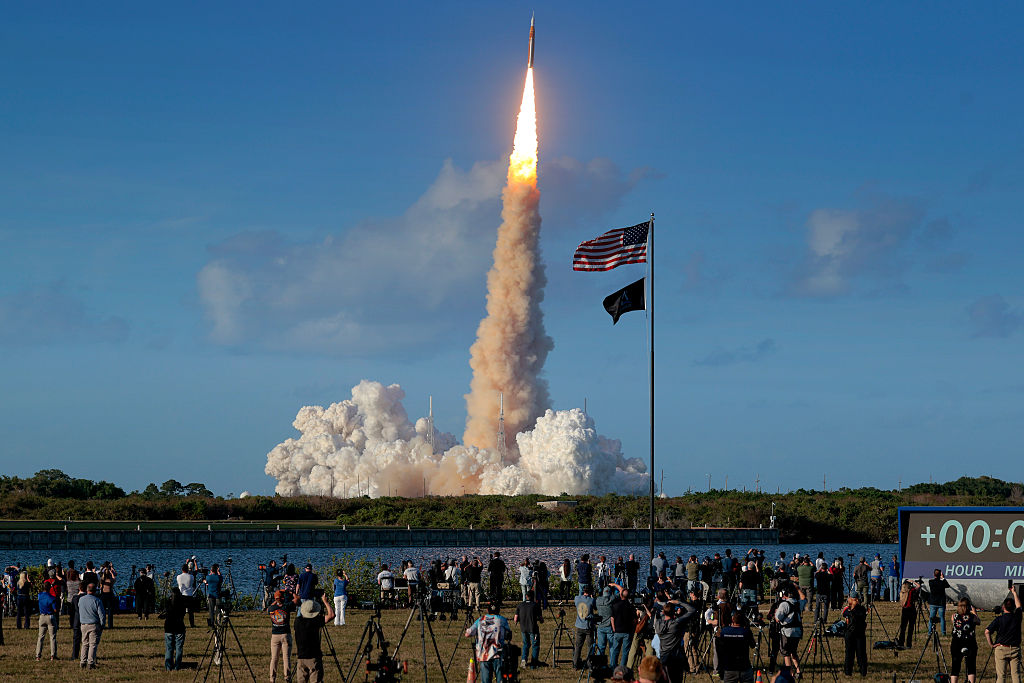
CAPE CANAVERAL, Fla. — Four astronauts blasted off Wednesday on a high-stakes mission around the moon, marking humanity’s first crewed lunar journey in more than 50 years and kicking off NASA’s plan to land astronauts there within two years.
The towering 32-story rocket lifted off from Kennedy Space Center before tens of thousands of spectators, with crowds lining nearby roads and beaches in scenes reminiscent of the Apollo era. The mission represents NASA’s most significant move yet toward building a lasting human presence on the moon.
“On this historic mission, you take with you the heart of this Artemis team, the daring spirit of the American people and our partners across the globe, and the hopes and dreams of a new generation,” launch director Charlie Blackwell-Thompson told the crew just before liftoff. “Good luck, Godspeed Artemis II. Let’s go.”
Launching from the same site that sent Apollo astronauts to the moon decades ago, Artemis II drew cheers from some of the few surviving moonwalkers as the Space Launch System rocket roared into the evening sky, heading toward a nearly full moon about 248,000 miles away.
Commander Reid Wiseman led the crew with the words, “Let’s go to the moon!” He was joined by pilot Victor Glover, mission specialist Christina Koch and Canadian astronaut Jeremy Hansen. The team is the most diverse ever assembled for a lunar mission, including the first woman, first person of color and first non-American to travel to the moon aboard NASA’s Orion capsule.
Before launch, the astronauts formed heart shapes with their hands as they said goodbye to loved ones and boarded the astrovan. “Love you guys,” Glover said.
After liftoff, communication between Mission Control and the crew focused on system checks and trajectory updates. About five minutes into the flight, Wiseman spotted their destination: “We have a beautiful moonrise, we’re headed right at it,” he said.
There was a brief communications interruption roughly 51 minutes after launch, but contact was quickly restored without further issues.
“After a brief 54-year intermission, NASA is back in the business of sending astronauts to the moon,” NASA administrator Jared Isaacman said during a postlaunch briefing. “We will hold our celebration until this crew is under parachutes and splashes down off the west coast of the United States.”
Mission timeline and objectives
The 10-day mission begins with about 25 hours in Earth orbit, allowing astronauts to test the Orion capsule before firing its engine to head toward the moon.
Unlike Apollo 8, Artemis II will not enter lunar orbit. Instead, the spacecraft will fly past the moon and travel about 4,000 miles beyond it — farther than any humans have ever gone — before looping back to Earth for a Pacific Ocean splashdown.
While in Earth orbit, the crew took manual control of the capsule and practiced maneuvering near the rocket’s detached upper stage, coming within 33 feet. NASA wants to ensure astronauts can pilot Orion if automated systems fail.
During the lunar flyby, astronauts will observe the moon — which will appear about the size of a basketball held at arm’s length — and capture images through Orion’s windows. If lighting conditions cooperate, they may see features never before observed by human eyes. They’ll also witness parts of a total solar eclipse, using protective glasses as the moon briefly blocks the sun and reveals its corona.
High stakes for NASA’s lunar future
Artemis II is critical to NASA’s long-term lunar ambitions, which include frequent missions and eventually a sustainable base supported by robotic systems.
The mission follows Artemis I, an uncrewed test flight more than three years ago. That earlier mission lacked life-support systems and other essential crew equipment, all of which are being tested now for the first time — increasing the mission’s complexity and risk.
“There’s always been a lot riding on this mission,” NASA’s Lori Glaze said before launch, noting renewed momentum under Isaacman’s leadership as NASA accelerates its lunar plans.
With many people alive today having no memory of the Apollo program, Artemis represents a fresh chapter in space exploration.
“There are a lot of people who don’t remember Apollo. There are generations who weren’t alive when Apollo launched. This is their Apollo,” said NASA science chief Nicky Fox.
NASA aims to establish a long-term presence on the moon, unlike the short-lived Apollo missions. The agency is targeting a landing near the lunar south pole later this decade, with Artemis IV now expected to carry astronauts to the surface in 2028.
Risks and challenges
Like Apollo 13, Artemis II is using a free-return trajectory that relies on the gravitational pull of Earth and the moon to guide the spacecraft home efficiently.
However, risks remain. NASA has not released full details of its safety assessment, saying only that the odds are better than the typical 50-50 chance associated with new rockets.
The Space Launch System has faced technical issues, including hydrogen fuel leaks and helium blockages that delayed the mission. Artemis I also returned with unexpected heat shield damage. Although Wednesday’s launch countdown was free of leaks, minor issues arose in the final hours.
Former Apollo astronaut Charlie Duke acknowledged the risks but expressed support, writing to the crew: “I’m cheering you on.”
The crew
Reid Wiseman, a former Navy captain and experienced astronaut, commands the mission. He previously spent 165 days aboard the International Space Station and conducted multiple spacewalks.
Victor Glover, the mission’s pilot, has also served aboard the ISS, logging 168 days in space and completing four spacewalks. He previously piloted NASA’s SpaceX Crew-1 mission.
Christina Koch, a mission specialist, holds the record for the longest single spaceflight by a woman, with 328 days in orbit. She also took part in the first all-female spacewalk.
Jeremy Hansen, representing Canada, is making his first trip to space. He previously participated in an undersea mission designed to simulate deep-space exploration.
Looking ahead
For the crew, the mission is about more than exploration — it’s about inspiring future generations.
“It is our strong hope that this mission is the start of an era where everyone, every person on Earth, can look at the moon and think of it as also a destination,” Koch said.
Glover added: “It’s the story of humanity. Not Black history, not women’s history, but that it becomes human history.”