State Senator Freeman Discusses Future Transit Issues in Indy and Beyond
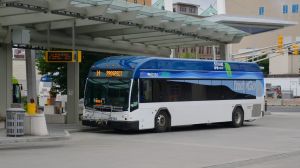
Source: (Photo by IndyGo.)
INDIANAPOLIS–The Blue Line is supposed to open in Indianapolis by 2027. Republican State Senator Aaron Freeman is not against the Blue Line, but he does have concerns.
“You start hearing all of the people say, ‘You want to kill the Blue Line.’ No, we want to kill dedicated lanes,” said Freeman in a Tuesday interview with 93 WIBC’s Hammer and Nigel.
The Blue Line is supposed to provide rapid transit along Washington Street between Cumberland and the Airport, using I-70 west of Holt Road. Service will replace existing Route 8. IndyGo says the goal is to provide fast, frequent and reliable transit service for its entirety of 24 miles.
“They want to take Washington Street from Hancock County to Hendricks County. It’s two lanes each direction with a turn lane in the middle right now. They want to eliminate the turn lane for bus stations and they want to take one lane each direction for buses. They want to turn Washington Street into a one lane road and they’re getting federal funds to do that,” said Freeman.
Freeman argues there is no way for the service to be fast, frequent, and reliable if you have dedicated lanes to buses.
“Just do shared lanes. There is federal money that is available to you, but IndyGo will not do it. They are solely focused on dedicated lanes,” said Freeman.
Freeman says he’s also heard concerns from several business owners along this route that will be hurt by all of the construction that would happen. There was also a meeting in the Senate where business owners from Irvington and all around East Washington Street.
“Not one person in that meeting said, ‘Let’s do away with public transit. Let’s do away with the Blue Line.’ Not one person said that. Everybody, however, said let’s do away with dedicated lanes because it’s really going to cripple my business,” said Freeman.
Construction on the Blue Line is supposed to between late 2024 and the spring of 2025. It’s price tag is expected to be about $400 million.
You can listen to the full interview with Freeman below.