AUDIO: All About the “Bullet” in Delphi Trial Day Seven

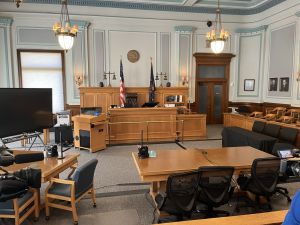
Source: Dave Bangert / @DaveBangert
DELPHI, Ind. — The unspent cartridge that helped police secure a search warrant and eventual arrest of Richard Allen is the subject of testimony in Carroll County Friday.
Richard Allen is charged with four counts of murder for the 2017 killings of teenagers Abigail Williams and Liberty German. In the original charging documents, an unspent 40-cal cartridge found near the bodies was traced to Allen’s gun.
During the morning session of Delphi trial day seven, the State of Indiana called witness Melissa Oberg. She works for a clinical asset health management company as an operations data analyst, but she previously worked for Indiana State Police as a forensic firearm examiner. She is the one responsible for testing Allen’s gun and confirming, in her opinion, that the crime scene cartridge was cycled through Allen’s gun.
Oberg spent the morning session testifying, in granular detail, the process in which she would test guns, the structure of a gun and the structure of a cartridge. Oberg explained to the jury that a cartridge is a single unit of ammunition, designed to go into a firearm. A cartridge features a casing, primer, powder, and bullet, which is the projectile.
Oberg was tasked with conducting a tool mark examine of the crime scene cartridge and a brand-new cartridge run through Allen’s gun.
“A tool mark is features imparted on an object by the contact and force extended from a tool,” Oberg testified before the jury.
Oberg testified to two kinds of tool marks: impressed and striated.
Some tool marks can be made before, during and/or after manufacturing of a cartridge, Oberg said.
The actual cartridge versus the test cartridge
Oberg testified the crime scene cartridge was a good condition, Winchester brand 40 cal. cartridge. Oberg also noted the cartridge was tested for DNA first and there was no biological substance on it. Testimony from law enforcement throughout the last week has been consistent with the fact that Richard Allen’s DNA was not located at the crime scene.
Oberg testified that there were three possible ejector marks: one in one direction and two in another.
Oberg testified to testing a new cartridge using Allen’s gun.
Five images displayed by Oberg show the tool markings were “in agreement”, but she also testified to firing the new cartridge, while the crime scene cartridge was cycled.
Oberg claimed in court that there is “research to back up doing it that way.”
By all accounts, the rest of Friday’s testimony was dull and dreadfully long. Reporters in the courtroom say Oberg’s testimony, which went so long another planned witness was pushed to Saturday, appeared to have “bored” the jury.
Oberg and defense attorney Brad Rozzi had a contentious back and forth exchange where Rozzi continued to press Oberg on the fact that cycling a cartridge is different than firing one.
Oberg continued to disagree, saying it’s only a matter of pressure. Also pointed out by other pool reporters was the fact that Oberg used the exhibit numbers to state that Allen’s gun cycled the crime scene cartridge instead of just saying it in a normal way, which appeared to not have the impact on the jury that the State may have intended.
The “DNA expert” planned for Friday’s testimony will instead speak Saturday. So far, not one individual has been able to provide proof of Allen’s DNA at the crime scene or on the victims.
An alternate juror also left early Friday due to a family emergency, said Special Judge Fran Gull. It’s unclear if that juror is gone for good.
You can hear a full breakdown from the WIBC Hammer and Nigel Show, featuring Second Amendment attorney Guy Relford and WIBC newsman Donnie Burgess. This discussion was recorded at 5 o’clock Friday afternoon.